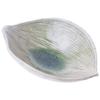
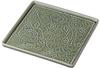
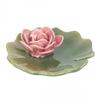
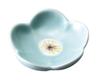
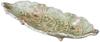
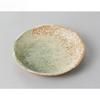
◆This ceramic offering plate for offerings is made in Japan from Mino ware. This lotus leaf-shaped offering plate features a lotus leaf motif. Crafted in Mino ware, a region famous for its elegant color and dignified texture, it is a reliable, domestically produced Buddhist altar accessory.
Even offerings containing liquid, such as "mizu no ko" (water larvae), often placed on lotus leaves and often used for Obon, can be safely used. It can also be used for everyday use, such as on the Buddhist altar tray or sutra table. Offer sweets or fruit as an offering.
■How to make "mizu no ko" (water larvae) for Obon. Dice the cucumber and eggplant and soak them in water. If you have time, submerge the eggplant in boiling water and then cool it in cold water to maintain its color and keep it beautiful. Combine the washed rice with the cucumber and eggplant, place on a lotus leaf, and soak. In some regions, the offerings are placed on the lotus leaf without soaking.
■Mino ware is a general term for ceramics produced in the Tono region of Gifu Prefecture (Toki City, Tajimi City, Mizunami City, Kani City), and is certified as a traditional craft by the Ministry of International Trade and Industry (now the Ministry of Economy, Trade and Industry). The Tono region is Japan's ceramics production base, accounting for approximately half of Japan's ceramics production.
![Butsuendo Brand: Japanese Buddhist Altar Supplies [Mino Ware: Lotus Leaf Offering Plate (Ceramic)] for Obon, Memorial Day, Buddhist Altar, Offerings,](https://img.joomcdn.net/692b0f89619dbdabd1959b7318a6986beed9d517_original.jpeg)
![Butsuendo Brand: Japanese Buddhist Altar Supplies [Mino Ware: Lotus Leaf Offering Plate (Ceramic)] for Obon, Memorial Day, Buddhist Altar, Offerings,](https://img.joomcdn.net/46aeafd873fa9b5648b88372eb9b1e55874e0d05_original.jpeg)
![Butsuendo Brand: Japanese Buddhist Altar Supplies [Mino Ware: Lotus Leaf Offering Plate (Ceramic)] for Obon, Memorial Day, Buddhist Altar, Offerings,](https://img.joomcdn.net/22b177c9f5d978fca2fbd1b8e8b9f33d3857d49c_original.jpeg)
![Butsuendo Brand: Japanese Buddhist Altar Supplies [Mino Ware: Lotus Leaf Offering Plate (Ceramic)] for Obon, Memorial Day, Buddhist Altar, Offerings,](https://img.joomcdn.net/1f28d6a2eacccaa805f66b14eb6c4d2c74d705e8_original.jpeg)
![Butsuendo Brand: Japanese Buddhist Altar Supplies [Mino Ware: Lotus Leaf Offering Plate (Ceramic)] for Obon, Memorial Day, Buddhist Altar, Offerings,](https://img.joomcdn.net/20816649f75ae7ee136c1dc81ab8f6d0edb4ca1f_original.jpeg)
![Butsuendo Brand: Japanese Buddhist Altar Supplies [Mino Ware: Lotus Leaf Offering Plate (Ceramic)] for Obon, Memorial Day, Buddhist Altar, Offerings,](https://img.joomcdn.net/4077aec57d4173c174306983e360f22b6ad72962_original.jpeg)